
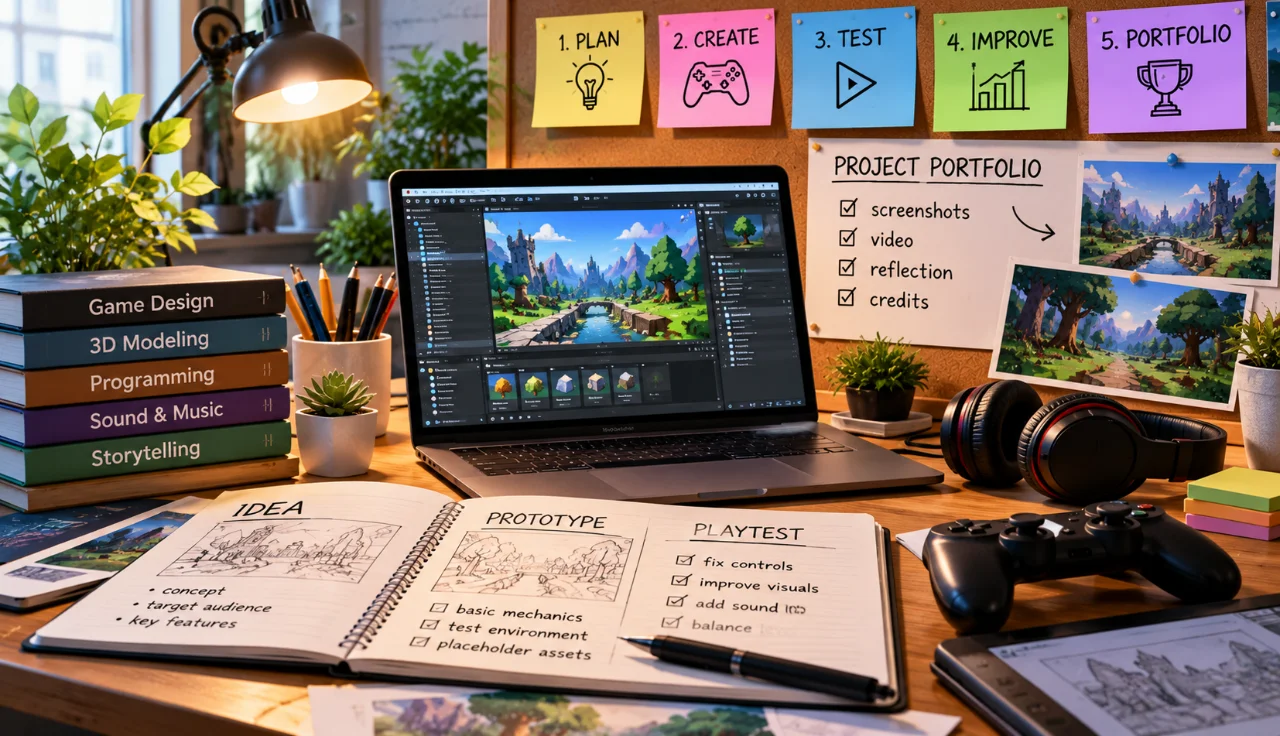
A highlight reel tells you what made the cut. It doesn’t tell you who planned it, where the first idea failed or what the student changed after someone else looked at it. If we want gaming and media projects to count as learning, we need to see some of that work, not just the final upload.
When I ask what a student did on a project, “I made the video” isn’t quite enough. Did they choose the clips, sort out the sound, write the captions, check permissions? A useful portfolio answers those questions with a few pieces of evidence. It gives the designer, writer or event planner something to show too, even if they never played in the match.
Start with the brief
I would give students a brief they can fit on half a page: what they are making, who it is for and where it will appear. A graphic for a classroom screen can afford small details that will vanish on a phone. A public stream brings different rules about names, images and music. Put those limits in the brief before anyone starts making things.
Then leave room for the student’s own choices. If the brief reads like instructions for every colour and cut, there is little left to explain in the portfolio.
Save one early version
Keep an early draft. It might be a rough video sequence, a hand-drawn graphic or the first running order for an event. Ask the student to add a note about what they were trying to do and what was still bothering them. That is enough to make a later change visible.
Nobody needs a folder full of nearly identical screenshots. Pick one version that shows the starting point and move on.
Record feedback and a decision
Now put the draft in front of someone else. If a classmate cannot read the date on a thumbnail at phone size, record that. If a teacher spots a missing technical check in the event schedule, record that too. The portfolio needs the comment and the student’s decision about it. “I made the date larger so it worked on a phone” is useful evidence. “I improved the design” could mean anything.
Sometimes the student will keep the original choice. That’s fine if they can explain why it still serves the audience. Feedback is a conversation, not an instruction to change everything.
Show the revision
Show the old and new versions side by side. Point to a change that matters: clearer audio, a simpler graphic, an event plan that gives the team time to test its stream. If a student removed a song because they could not use it, include that decision as well. These are small, concrete things a teacher can actually discuss with them.
The work behind a school event is wider than the match itself. Someone has to plan, write, design and produce it. In the school curriculum I work on at Squid Academy, we include portfolio development among those roles. The question is the same in any school: what did this student decide, and what can they show to explain it?
Add credits and a short reflection
Credits belong in the evidence too. Ask who made each part, where images and music came from, and what permission the team had to use them. If students appear in a photo or stream, follow the school’s rules before it goes anywhere public. A private portfolio may be the right place for the work even when public posting is off the table.
I would finish with a short reflection, not a victory speech. What would the student keep? What would they change if they had another afternoon? Which choice can they now explain better? Answers that admit something was awkward or unsuccessful are often more revealing than “everything went well.”
A small example
Take a student making a thumbnail for a school tournament video. The first version looks fine on a laptop, but the date disappears on a phone. They save it, note the feedback, enlarge the type and keep the approved photo credit beside the final file. A reviewer can see the problem and the response in minutes. Without that trail, the thumbnail is simply a thumbnail.
Keep it manageable
I would not ask a teacher to learn another platform for this. A shared folder and a short document will do. Give students six prompts at the start: brief, early version, feedback, revision, credits and reflection. They can collect the pieces while they work. Ask for them after the event and they will have to reconstruct decisions they barely remember.
That also makes review less dependent on who played well or stood in front of the camera. A teacher can ask each student to talk through one decision and check it against the saved work. If the answer is vague, the next question is easy: show me the draft or the feedback that led you there. When the team did the work together, ask each student to name their own contribution and one thing a teammate changed. That tells you more than a shared slide that gives everyone the same credit.
There is no prize for the thickest portfolio. I want to see enough to understand the student’s part in the project and hear them explain a choice or two. The finished event can still be the thing everyone enjoys. The portfolio lets us notice the work that made it happen.
Editor’s related reading: From Gamers to Game Creators: How a High-School Team Built a Game for Steam.