
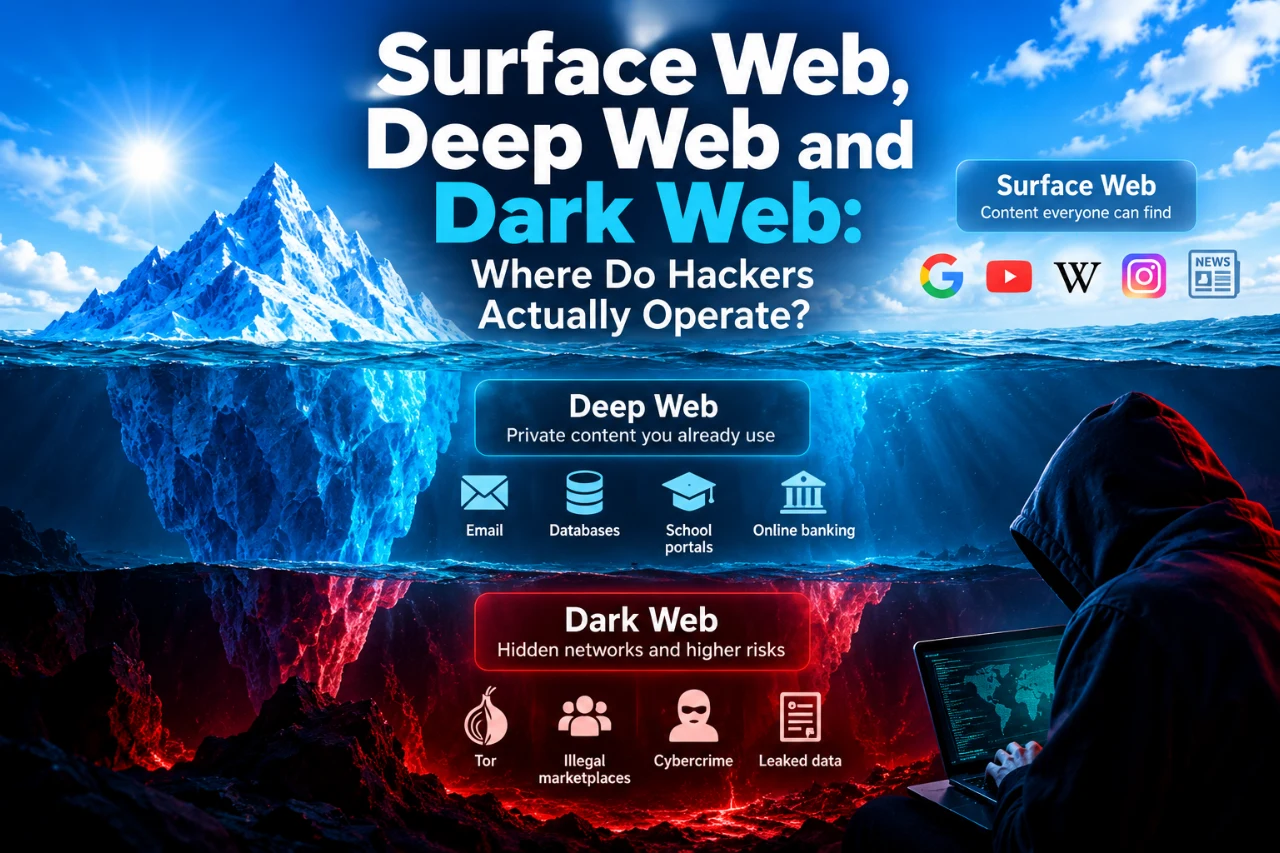
Imagine receiving an email that appears to come from your bank. It has the right logo, familiar colors, and an urgent warning about your account. You click a link, enter your password, and later discover that the message was fake.
Was the hacker hiding on the mysterious Dark Web? Perhaps—but the attack itself may have happened entirely on the ordinary internet you use every day.
That is one of the biggest misunderstandings about the Dark Web: cybercrime does not belong exclusively to a hidden digital world. To understand where hackers operate, we first need to distinguish the Surface Web, Deep Web, and Dark Web.
The internet is bigger than what Google shows you
Search engines discover and index many public pages, but they do not display every piece of web content. Your email inbox, banking dashboard, and school portal are also accessed through the web, yet their private contents are not publicly searchable. Other services operate through specialized privacy networks such as Tor.
1. Surface Web: The part everyone can find
The Surface Web (or Open Web) consists of public web content that conventional search engines can discover and index: news articles, educational websites, public forums, online stores, and company websites.
Not being indexed does not automatically make a page part of the Dark Web. A public page that Google has not discovered can still be accessible in an ordinary browser.
2. Deep Web: The private part you already use
The Deep Web is web content not indexed by ordinary search engines. Much of it is entirely routine: private email, online banking, school portals, medical records behind logins, company intranets, subscription content, and private databases.
You usually do not need special network software to access it—just the correct account or permission. The Deep Web is not inherently suspicious; privacy and access controls are normal parts of the internet.
3. Dark Web: Services on specialized networks
The Dark Web refers to content accessible through specialized networks or configurations designed to provide additional privacy or anonymity. The best-known example is Tor. Some Tor-hosted sites use addresses ending in .onion, called onion services.
An onion service can conceal the network location of the server. That can protect journalists and confidential sources, but the same privacy properties can be misused for criminal activity. The technology alone does not tell you whether its use is legitimate.
Surface Web vs Deep Web vs Dark Web
| Feature | Surface Web | Deep Web | Dark Web |
|---|---|---|---|
| Typical example | Public news article | Private email inbox | Tor onion service |
| Indexed by ordinary search engines? | Often | Generally not | Generally not |
| Special network software required? | No | Usually no | Often yes |
| Automatically illegal? | No | No | No |
| Can criminals use it? | Yes | Yes | Yes |
| Main distinction | Public discoverability | Not publicly indexed | Specialized privacy network |
So where do hackers actually operate?
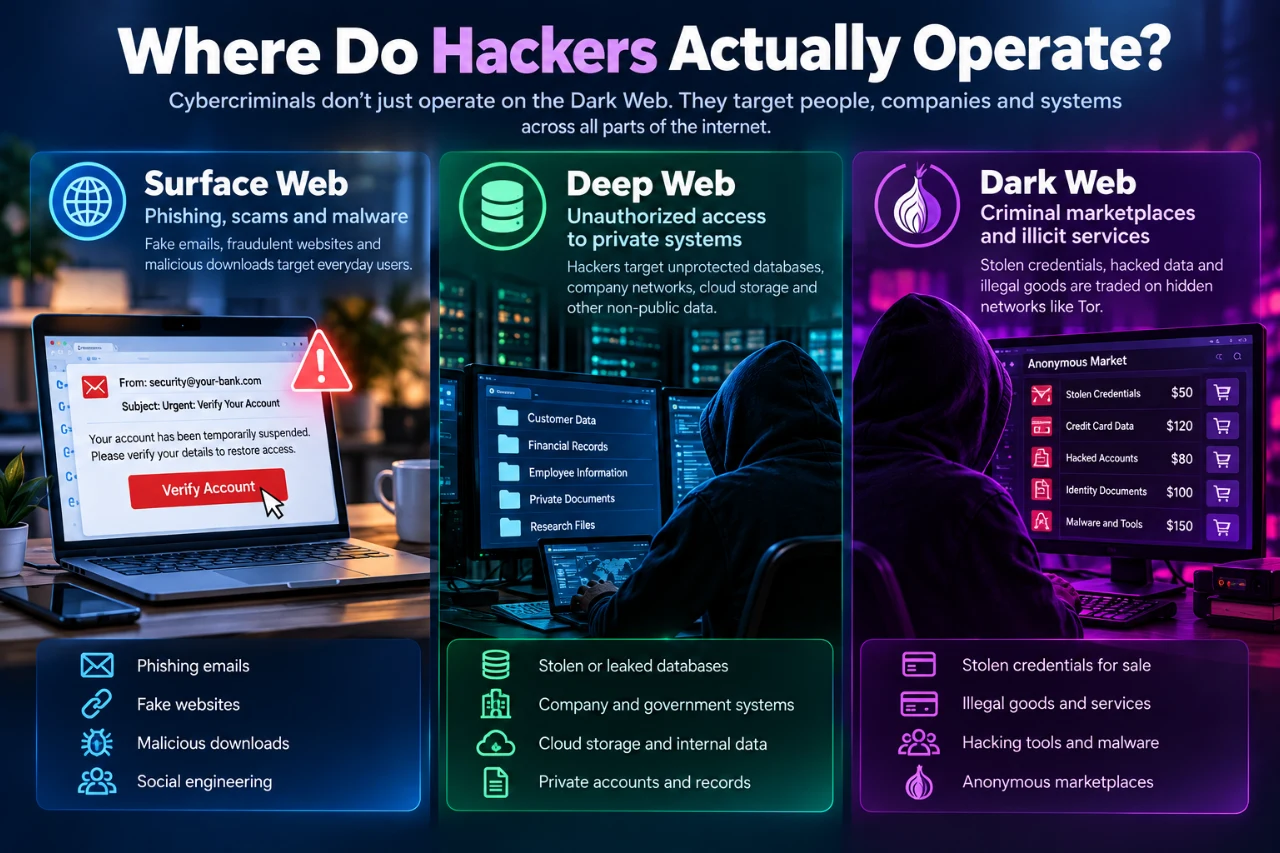
Across all three. Many attacks on ordinary people do not require the Dark Web at all.
Example 1: A phishing attack on the ordinary web
A criminal creates a fake login page resembling a familiar service, then sends a convincing email or social media message. The page may be hosted on conventional web infrastructure with an ordinary domain name. The victim never visits the Dark Web.
Example 2: Unauthorized access to a private account
An attacker who compromises an employee account may reach confidential documents or internal systems. Those resources may be part of ordinary business services behind a login—not Dark Web sites. The problem is unauthorized access.
Example 3: Stolen data traded in criminal networks
After a breach, stolen credentials and access to compromised systems may be advertised on illicit marketplaces or forums, including some onion services. But criminals also use ordinary websites, messaging platforms, and other online infrastructure. Europol’s 2025 assessment describes stolen data as a commodity that enables further fraud, extortion, and cyberattacks.
Are all hackers criminals?
No. Ethical hackers test systems with authorization to find weaknesses and improve defenses. Security researchers investigate vulnerabilities and malicious activity. Malicious hackers break into systems without authorization, steal data, or cause harm. Their technical knowledge may overlap; permission, intent, and conduct make the difference.
Why would anyone use the Dark Web legitimately?
Privacy is not automatically suspicious. Journalists and confidential sources may need communication methods that reduce the risk of exposing their identities. SecureDrop, an open-source system used by news organizations, relies on Tor to support confidential submissions and communication. Other legitimate uses include resisting censorship, security research, and protecting sensitive conversations.
How does Tor actually work?
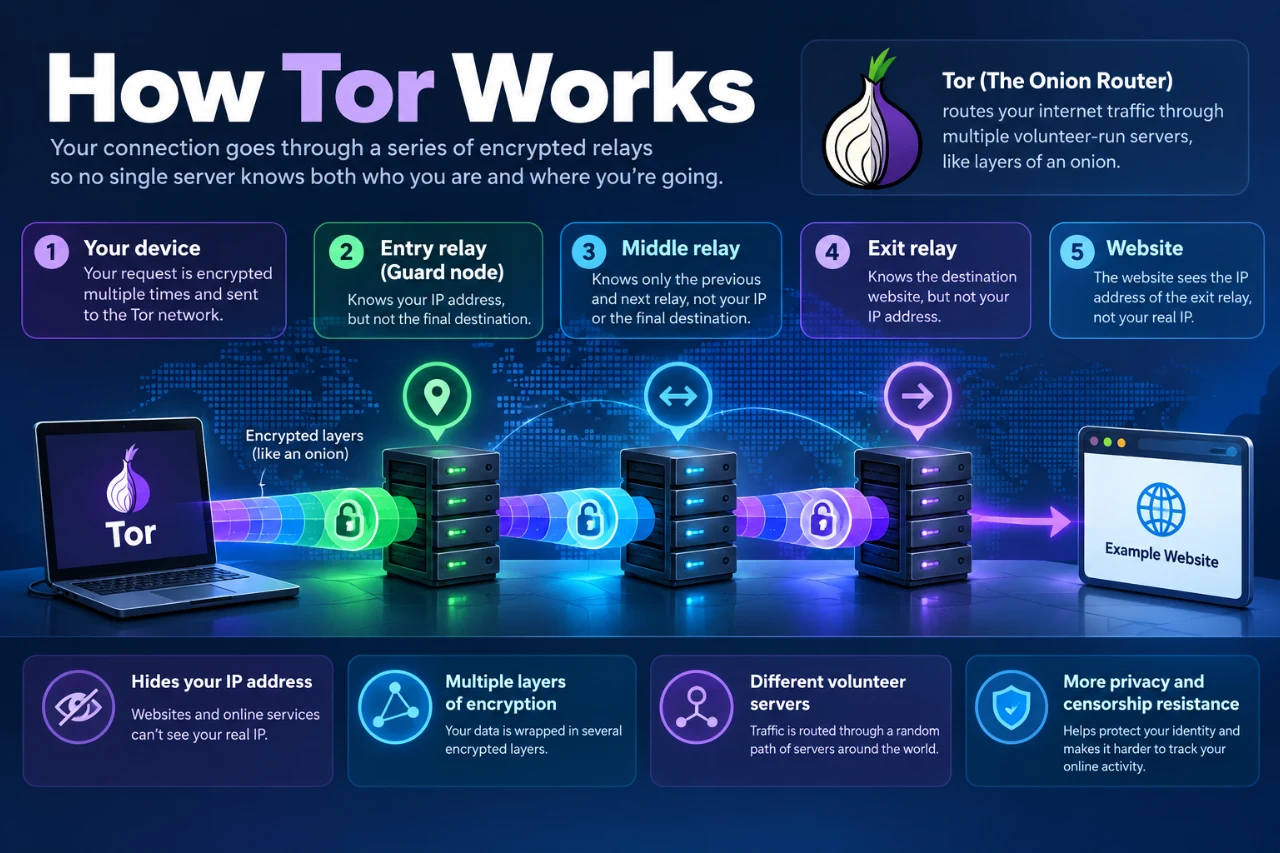
Tor, short for The Onion Router, ordinarily routes Tor Browser traffic to a conventional website through multiple relays. A simplified route is your device → entry relay → middle relay → exit relay → website. The destination generally sees the exit relay’s IP address instead of yours; no single relay ordinarily knows both your identity and your destination. Onion services use a different arrangement that keeps connections within Tor and can hide the server’s location. Read more in the Tor Project’s official documentation.
Does Tor make someone completely anonymous?
No technology guarantees anonymity in every situation. Signing into an account under your real name can identify you even if your IP address is concealed. Tor Browser does not automatically route every other application on your computer through Tor. Sophisticated attacks, including traffic correlation, can also threaten anonymity under certain conditions.
It helps to separate four goals: hiding a network address, encrypting communication contents, preventing tracking, and keeping a real-world identity private. These are related, but not identical.
Can Dark Web websites use cookies?
Yes. Onion websites can set browser cookies just like ordinary websites. A cookie can let a site recognize your browser while you navigate between pages, even if the site cannot see your real IP address. Tor Browser is designed to isolate website data and normally clear cookies when the browser session ends, but that does not prevent every form of tracking or identification.
For example, an onion site could assign a visitor a session cookie, recognize that visitor on the next page, and lose that particular cookie when the visitor fully closes and restarts Tor Browser. Account logins, browser fingerprinting, and other clues can still matter. We will explore these distinctions in a dedicated article about cookies and tracking.
Is visiting the Dark Web illegal?
In many jurisdictions, using Tor or accessing lawful onion services is not inherently illegal. Laws vary by country, however, and criminal conduct remains criminal regardless of the network used. Buying illegal goods, stealing data, or accessing systems without authorization does not become lawful because Tor is involved.
Is Web3 another part of the Dark Web?
No. Despite its name, Web3 is not another layer of the internet alongside the Surface Web, Deep Web, or Dark Web. Web3 generally refers to blockchain-based applications, decentralized systems, and digital ownership. A Web3 application can operate on the ordinary web, and some services may also use Tor. These terms describe different aspects of how online technologies work.
Five Dark Web myths worth questioning
Myth 1: The Deep Web and Dark Web are the same thing
False. Your private email inbox is Deep Web content, but it is not a Tor onion service.
Myth 2: Everything on the Dark Web is illegal
False. Privacy-preserving services can support journalism, research, and lawful communication.
Myth 3: Hackers only operate on the Dark Web
False. Phishing, account theft, malware, and many other attacks use ordinary internet infrastructure.
Myth 4: Tor makes you impossible to identify
False. Tor provides meaningful privacy protections, not a universal guarantee against identification.
Myth 5: The Dark Web has mysterious numbered levels
Viral stories about secret, increasingly dangerous levels are not a recognized technical model of how the web works.
What should ordinary internet users actually worry about?
For most people, the most effective protections are less dramatic than exploring hidden websites: use unique passwords, enable multifactor authentication or passkeys where available, keep software updated, and be skeptical of urgent messages and unexpected login requests. Understanding online safety is also a core digital skill, as we explain in our guide to digital skills students should learn before university.
A reputable password manager can make unique passwords practical across hundreds of accounts, although password vaults also introduce risks if a provider is breached or a device is compromised. That trade-off deserves a separate article—not a blanket claim that any storage method is perfectly safe.
A question worth exploring
Suppose you open a website right now. Who can see your connection: your internet provider, the website, your employer, or a VPN company? The answer depends on encryption, network configuration, and privacy tools. That’s where our next investigation begins: What Is Tor, and How Does It Hide Your IP Address?
Frequently asked questions
Is the Dark Web bigger than the Surface Web?
There is no reliable universal measurement establishing the Dark Web’s exact share of all web content. Be skeptical of dramatic percentages that confuse the Deep Web with the Dark Web.
Can Google search the Dark Web?
Ordinary search engines generally do not index onion services in the same way as public websites, although information about onion services can appear on the public web.
Is the Deep Web dangerous?
Not inherently. Many everyday private accounts and databases are Deep Web content. Their security depends on how they are protected and used.
Can you access the Deep Web without Tor?
Yes. Email, banking, and school portals are usually accessed with ordinary browsers.
Do you need to visit the Dark Web to learn cybersecurity?
No. You can learn about Tor, privacy, cybercrime investigations, and digital security from legitimate public documentation and educational research.