
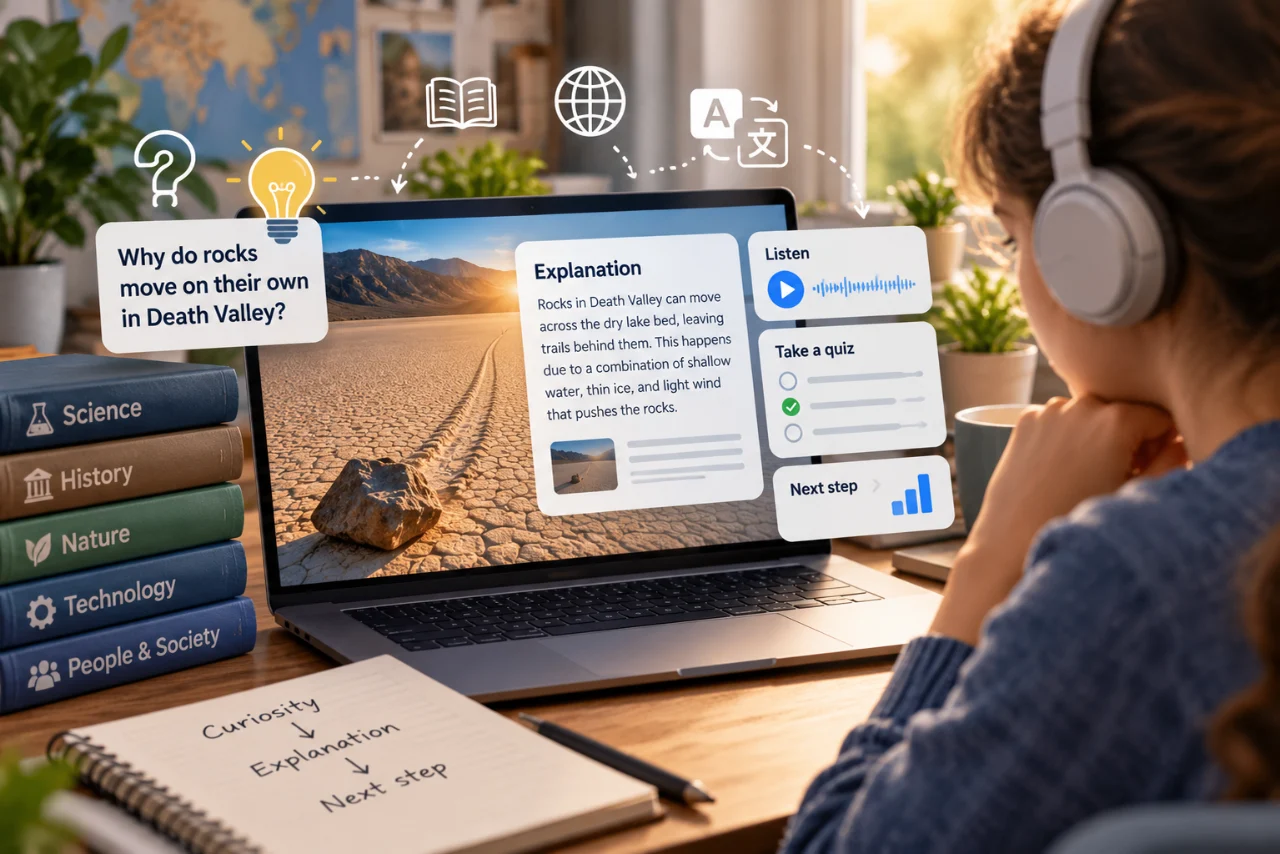
I started Watt because I like learning things I did not know I wanted to learn. A question leads to an explanation, the explanation leads to another question, and suddenly an ordinary subject becomes interesting. The difficulty was that the material I wanted was scattered across websites, with different levels of detail and very different standards of evidence. Collecting facts in one place seemed useful. Building that place taught me that collecting them was only the beginning.
Watt is now a free library of more than 2,000 facts in Ukrainian and English. Readers can explore topics, choose an explanation level, read or listen, and try a short quiz. I built it as a solo founder, and its development has involved the content workflow as much as the interface. My experience is a product-building story, rather than evidence that this format improves learning. I have not yet measured educational efficacy.
Why a surprising fact needs an explanation
The first challenge was deciding what a useful fact page should actually do. A surprising sentence can attract attention, but it may also leave the reader with a misleading impression. Consider the rocks that leave trails across Racetrack Playa in Death Valley. Saying that the rocks move is intriguing. Explaining the observed combination of shallow water, thin ice panels and light wind gives the reader something more useful: a mechanism to understand. The sources behind that explanation matter because they distinguish a recorded observation from an appealing story.
That example also shows why brevity is a difficult editing problem. A short version should keep the mechanism intact. A longer version can explain how researchers observed the movement and why the conditions occur infrequently. Adding more words does not automatically make an explanation better, and removing words can accidentally remove the condition that makes a claim accurate. I came to think of explanation levels as different ways into the same subject, each of which needs to preserve the underlying meaning.
The challenge of keeping two languages accurate
Working in two languages makes that problem more visible. A translation can sound natural while changing the strength of a claim. Words such as “can,” “usually,” and “under these conditions” are small, but losing them changes what the reader is being told. A practical check is to compare the claim rather than just the wording: does each version describe the same mechanism, scope and uncertainty? Fluent language and factual agreement are separate requirements.
The same applies to a catchy title. A title about humans glowing needs an explanation that the light is too faint for unaided eyes and was measured with specialized equipment. It should not encourage the reader to confuse ultraweak photon emission with a thermal image. The useful editorial question is not just whether a sentence is technically defensible. It is what someone is likely to believe after reading it quickly.
Why audio narration changes the writing
Audio was another important part of the product. I wanted readers to be able to listen rather than making reading the only way to explore a subject. But narration makes weaknesses in writing easier to hear. A sentence with several qualifications may be understandable on screen and cumbersome aloud. References that work as links are not naturally spoken. Numbers and unfamiliar names can interrupt the flow. Treating audio as another version of the experience, rather than simply another file to generate, creates a reason to revisit the explanation itself.
Designing quizzes that reinforce understanding
Quizzes introduced a different kind of discipline. The question needs to be understandable on its own, and the options need one clearly intended answer. In the sailing-stones example, a useful question asks what actually pushes the rocks. It points back to the explanation’s mechanism. A vague question about whether the rocks are “mysterious” would mostly test the wording of the page. I want a quiz to give the reader another way to engage with an idea, while being careful not to interpret a correct click as proof of durable learning.
What early testers taught me about returning
Early testers pushed me to think beyond individual fact pages. Their feedback was that there needed to be something that made people want to return and continue. That influenced my work on the wider experience: topic choice, progression, saved interests and gamification. These features give curiosity somewhere to go after the first interesting page. For a broader look at how playful activities can support education, see TechEduCareer’s guide to game-based learning. The question became how to make the next step clear without turning every moment into a demand for another click.
Build one complete learning journey first
For someone building a similar product, I would start by making one complete journey work. Can a new visitor choose something interesting, understand it, hear it if they prefer, inspect the source, and answer a useful question? That journey exposes dependencies that a feature list hides. A quiz depends on an explanation. Narration depends on a usable script. A convincing illustration depends on an accurate caption and a clear account of its origin.
AI-assisted workflows still need human judgment
Connecting those pieces into an agent-assisted workflow has been one of the hardest parts. AI can help produce and revise material, but it does not remove the need to check claims, preserve source relationships or distinguish synthetic illustrations from documentary photographs. Nor does an automated sequence become reliable merely because it runs repeatedly. The meaningful unit of work is the complete page and the reader’s experience of it, rather than a count of generated assets.
What I still need to learn
The library’s growth gives me more opportunities to find inconsistencies, not a reason to assume the work is finished. I still need better evidence about which experiences people value, why they return, and what they remember. A growing content count, a successful publication or an encouraging comment can be useful signals, but they answer different questions. My main lesson is to keep those questions separate while building a path that is easy to try.
I began with a personal interest in unusual facts. The project has made me equally interested in what happens immediately after the surprise. A useful explanation, a voice to listen to, a source to inspect and a question to consider can give that moment somewhere to lead. Whether it becomes a lasting learning habit is something I still need to learn from the people using it.
Disclosure: The author is Watt’s founder. This article was prepared with AI writing assistance. Watt’s educational efficacy has not yet been measured.
Scientific references
- Norris et al., “Sliding Rocks on Racetrack Playa, Death Valley National Park: First Observation of Rocks in Motion,” PLOS ONE (2014). Read the study.
- Kobayashi et al., “Imaging of Ultraweak Spontaneous Photon Emission from Human Body Displaying Diurnal Rhythm,” PLOS ONE (2009). Read the study.