

An AI assistant can help you build a shortlist of master’s programmes. The moment an answer affects whether you apply, budget for a course or book a language test, check the source for that particular claim. A link to an official university page is a good starting point. Open it and find the passage that supports the answer for the right programme and intake.
Our team at Pixelclip examined about 42,000 interactions about master’s programmes, universities and business schools in Spain in August and September 2025. The benchmark covered ChatGPT, Gemini, Perplexity, Google AI Overviews and Microsoft Copilot. Across the sample, 76.1% of citations pointed to third-party sources. That figure tells us where the references pointed. The exercise below helps you check whether an individual source supports what the assistant says.
Source and methodology for the Pixelclip benchmark
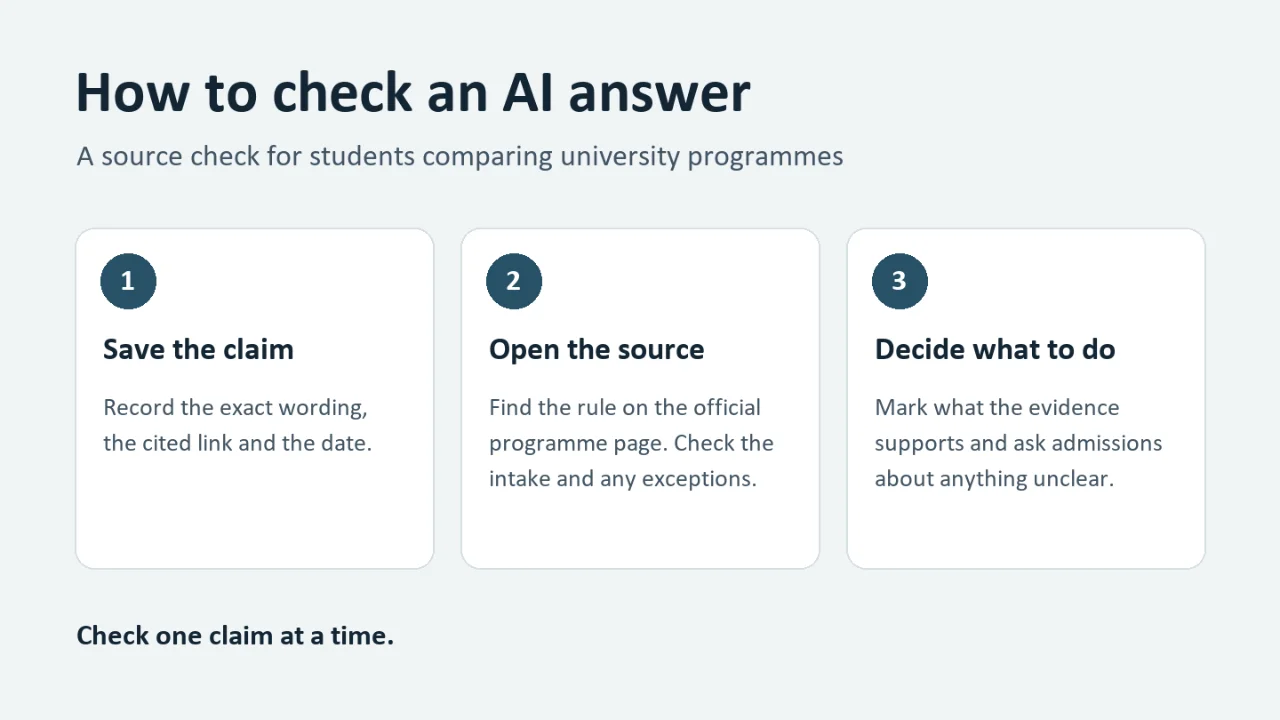
Run a source check on one programme
Start with a decision you need to make. Write down the exact degree, university and intake. Choose details that affect your plans, such as the teaching language, the documents you need, the application deadline or whether a placement is part of the course.
Ask the same question in two assistants. Keep the wording and intake identical and save each answer with its date. A question you can reuse is “For the [programme] at [university] for the [intake], what are the teaching language, admissions requirements, application deadline and placement options? Give the source for each claim and flag any detail you cannot verify.”
Put one claim on each row. Keep the original wording alongside the cited URL. Open the page and look for the exact condition, the relevant academic year and any exceptions. If an AI cites a ranking, a university homepage or an older prospectus, record that source and look separately for the current programme or admissions page.
Resolve the details that matter most. If a deadline or eligibility rule is still unclear, check the university’s application portal or ask the admissions team. For a deadline, name the intake and your applicant route. Keep a dated copy of the answer you receive if it affects your application.
Copy this comparison template
Use a separate row for each assistant and claim. Record the prompt once above the table so you can repeat the check later.
| Assistant and date | Claim and cited URL | Official evidence | Verdict and next step |
|---|---|---|---|
| Engine and date checked | Exact claim and the URL it cited | Programme, intake and relevant passage or official URL | Supported, needs context, contradicted or unverified. Record what to do next. |
Worked example from a Spanish university
Suppose you are considering the Master in Management at Universidad Carlos III de Madrid and your undergraduate degree was taught in English. An assistant might give you this answer with a single link to the programme page. The answer below was constructed for this exercise. The checks use the university’s published information.
Illustrative answer. “The programme is taught in English. Every applicant must take IELTS. The programme includes an internship.”
UC3M programme page, including the admissions and course structure sections. Checked 26 November 2026.
| Claim to check | What the official page says | Verdict |
|---|---|---|
| The programme is taught in English. | The admissions section says that English is the official language of the programme. | Supported. |
| Every applicant must take IELTS. | The programme lists several ways to demonstrate English proficiency. Applicants who completed undergraduate studies in English may qualify for an exemption with the relevant documentation. | Contradicted. Find out what evidence you can submit before booking a test. |
| The programme includes an internship. | The course structure lists internships as an elective. Students find a suitable placement and obtain academic approval. | Needs context. Check how the elective works if a placement is central to your decision. |
Before paying for IELTS, the student can ask admissions whether a degree transcript or a letter confirming the language of instruction would meet the documentation requirement. If they are counting on an internship, they can ask how the elective is approved and what support the careers team offers when students look for placements.
Use the exercise with students
In a careers or digital skills session, ask students to bring one programme they are genuinely considering. Give them ten minutes to check two claims, then compare evidence in pairs. A useful discussion starts when both assistants give the same answer. Ask each student to show the sentence on the official page that supports it. If the students used different pages, check whether each page covers the same programme, intake and applicant route.
Save the official pages and dates beside your shortlist. Recheck time-sensitive details when you are ready to act. A short record of verified requirements gives you something concrete to use when you compare offers, ask admissions a question or decide whether to apply.
AI use disclosure. ChatGPT was used to draft and edit this article and construct the illustrative answer. The benchmark data are from Pixelclip’s 2025 study.
Help others discover this article.
Discover more from Technology Education & Career
Subscribe to get the latest posts sent to your email.