
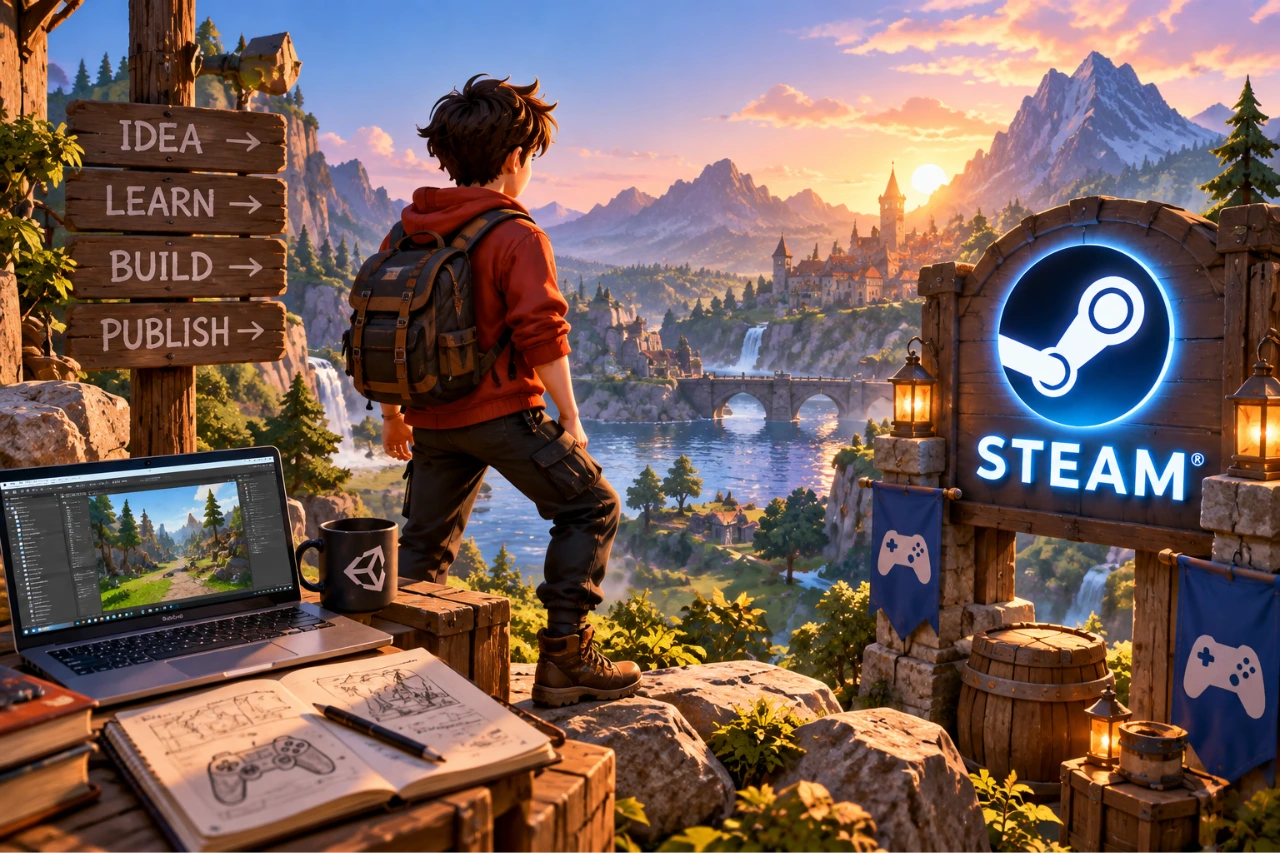
What Is Steam? How Anyone Can Create and Publish a Game
Have you ever wondered what Steam is, or who actually creates the games you play? Maybe you imagined a huge studio and a budget running into millions. But some successful games begin with one person, a computer, and an idea that refuses to go away.
But first, what is Steam, and how does it help independent creators? Today, independent creators can reach players around the world through platforms such as Steam. Is it just a place to download games, or can ordinary people publish their creations there too?
What Is Steam, and Why Is It So Popular?
Steam is an online gaming platform created by Valve Corporation. Launched in 2003, it has become one of the best-known places to discover, buy, download, and play PC games. Think of it as a digital game store combined with a personal library and an online community.
Additionally, Steam provides automatic updates, achievements, player reviews, multiplayer features, and community discussions.
Creating an account and downloading Steam are free. You can visit the official Steam website to explore free and paid games. You can also check the free-to-play section.
Who Uses Steam?
- Players discover games, play with friends, and share reviews.
- Independent developers publish games without necessarily needing a traditional publisher.
- Game studios distribute both smaller projects and major releases.
- Students and aspiring developers can explore game design and eventually publish their own work.
The same platform that hosts games from enormous studios can also host a project created by a small team. Of course, being listed doesn’t automatically mean millions of people will discover it.
What Are Steam Charts and Rankings?
The official Steam Charts help players explore popular games. Top Sellers ranks games by revenue over a specified period; Most Played highlights concurrent player counts. You can also explore new releases and yearly highlights.
For developers, these rankings offer clues about the gaming market. But popularity isn’t the same as quality: a small puzzle game with a few hundred enthusiastic fans can still be a wonderful achievement.
Can Anyone Publish a Game on Steam?
You don’t have to own a major studio. Independent developers can distribute games through Steamworks, Valve’s developer platform. But publishing involves more than dragging a file onto a website.
- Create your game. Tools such as Unity, Godot, and Unreal Engine can help you build a playable project.
- Register with Steamworks. Supply required identity, banking, and tax details.
- Pay the Steam Direct fee. Steam charges $100 per game, recoupable after $1,000 in adjusted gross revenue. A free game without revenue may never recover the fee.
- Prepare your store page. Add artwork, screenshots, a description, and system requirements.
- Upload and test. Valve reviews the store page and game build.
- Meet the waiting periods. First releases require at least 30 days after the fee payment, and a publicly visible Coming Soon page for at least two weeks.
- Release. Once the requirements are met, make the game available to players.
Are There Alternatives to Steam?
Absolutely. Different platforms serve different needs, and some are especially welcoming to beginners.
| Platform | Publishing cost | Best suited for |
|---|---|---|
| Steam | $100 per game | Indie developers seeking a large PC audience |
| Epic Games Store | $100 recoupable fee per game | Developers seeking another major storefront |
| itch.io | Free publishing option | Students, game jams, prototypes and hobbyists |
| GOG | Curated submission and commercial review | Games suited to its DRM-free catalog |
Steam
Steam has established player communities, reviews, wishlists, and discovery tools. Competition for attention can be intense.
Epic Games Store
Epic Games Store provides another major PC storefront. Under its current model, eligible developers retain 100% of their first $1 million in net revenue per product per year from transactions through Epic’s payment system, after which the standard 88/12 split applies. Store and technical requirements still apply.
itch.io
itch.io is particularly approachable for beginners: you can publish a small project without an upfront listing fee. Creators can choose their platform revenue share, although payment processing may still cost money.
GOG
GOG is known for DRM-free games. It uses a curated submission and selection process rather than itch.io’s open publishing model.
If you have just finished your first small game, itch.io may be a practical starting point. If you’re preparing a more complete PC release, Steam is worth exploring. There’s no universal winner.
Can Indie Game Developers Really Earn Millions?
Yes, some independent games have become extraordinary commercial successes. Their stories show that a small team doesn’t necessarily mean a small idea.
1. Stardew Valley
Stardew Valley, created by Eric Barone (ConcernedApe), began as a solo-developed farming and life simulation game. Its official press information reported more than 41 million copies sold across platforms by December 2024, including over 26 million on PC. A thoughtful idea can stand out without photorealistic graphics.
2. Terraria
Terraria, developed by Re-Logic, is a 2D sandbox adventure about exploration, building, and discovery. Its developers reported over 58 million copies sold across platforms in 2024. Its longevity also demonstrates the value of updates and community support.
3. Balatro
Balatro transforms familiar poker hands into an inventive roguelike card game. Created by solo developer LocalThunk, it passed 5 million copies sold across platforms by January 2025, according to its publisher. You don’t need an enormous virtual world to make something players love.
Does Every Indie Developer Become Rich?
Not quite! These are exceptional outcomes, not typical earnings. Copies sold, revenue, and personal profit are different things. Store commissions, refunds, discounts, taxes, contractors, and development costs all matter. Even releasing a small game enjoyed by a handful of people can be a meaningful achievement and a valuable portfolio project.
Can Students Create and Publish Their Own Games?
Yes. You don’t have to begin as a programming expert. Imagine a small maze game where a character must escape before time runs out. You’ll learn about movement, obstacles, collisions, sound, and how to make the game feel fair. Each feature becomes a problem to solve.
- Start small. Choose an achievable idea.
- Pick a game engine. Explore Unity, Godot, or Unreal Engine.
- Build a prototype. Make one gameplay mechanic work.
- Test with others. Friends may spot confusing controls or bugs.
- Improve and polish. Work on visuals, sound, performance, and menus.
- Prepare for release. Check store rules, intellectual property, account eligibility, and publishing responsibilities.
Students who are minors may need an eligible adult or legal representative to handle contracts and publishing arrangements. The important thing is that learning doesn’t have to end with a tutorial: you can build something of your own.
From an Idea to Steam: Meet Fallgate
We’ve previously introduced Fallgate and the story behind its development. Now there’s a new chapter: Fallgate was released on Steam on October 7, 2026, and is free to play.
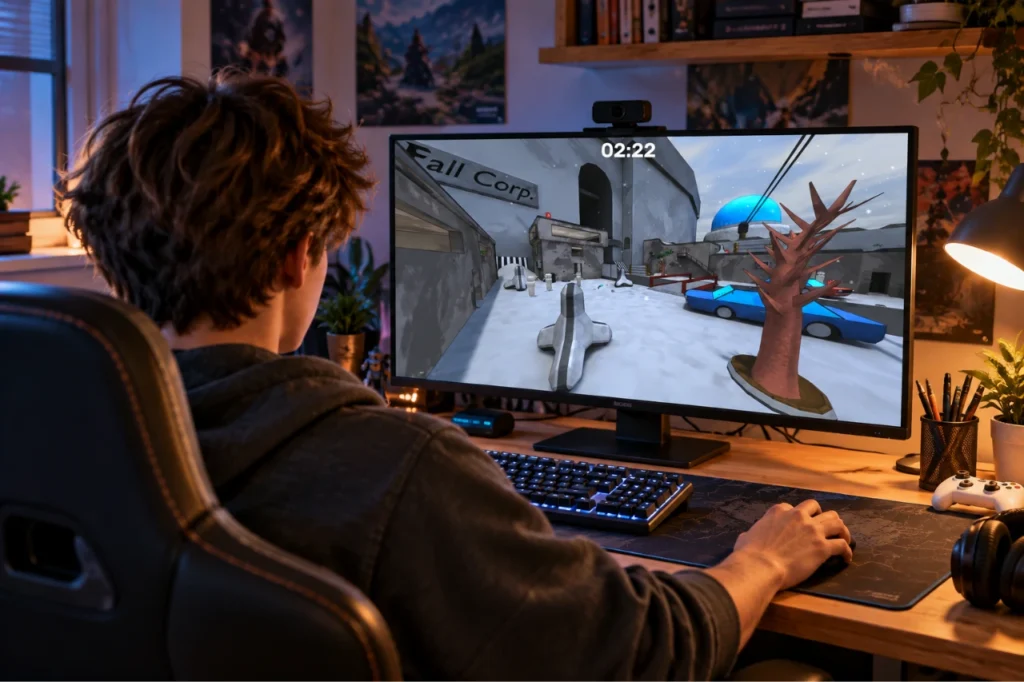
Fallgate is a multiplayer arena shooter featuring fast-paced first-person combat, advanced movement, projectile-based weapons, and competitive player-versus-player matches. It was developed by NoOne, Anon, and TSB and published by SinStone Games.
Its release is a real example of independent creators bringing a game to a major digital storefront. Getting there involves design, programming, testing, networking, and fixing bugs. And release day isn’t the end: feedback and updates remain part of the journey.
Want to Give Fallgate a Try?
Here’s the best part: Fallgate is free to play. There’s no game purchase or subscription fee required to access it. You’ll need a compatible PC, Steam, and an internet connection for multiplayer.
Whether you enjoy competitive shooters, want to discover an independent game, or are simply curious about what a small team can create, you’re welcome to try it. Play Fallgate for free on Steam. And if you enjoy it, consider sharing constructive feedback with its creators.
Frequently Asked Questions
Is Steam free to use?
Yes. Steam accounts and the application are free. Individual games may be paid or free to play.
Can I download free games on Steam?
Yes. Steam has a free-to-play section. Some games offer optional in-game purchases.
Can anyone publish a game on Steam?
Independent developers can apply through Steamworks if they meet legal, technical, payment, and review requirements. Minors may need an eligible adult to handle publishing.
How much does publishing on Steam cost?
The Steam Direct fee is $100 per game, potentially recoupable after $1,000 in adjusted gross revenue.
Is Steam better than Epic or itch.io?
It depends on your project. Steam has a large established ecosystem; Epic offers another major store; itch.io is especially accessible for small experimental games.
Can I earn money from a game I create?
Yes, but success is not guaranteed. Exceptional indie hits shouldn’t be treated as typical results.
What are Steam rankings?
They organize games by measures such as sales revenue and concurrent player counts.
Is Fallgate free to play?
Yes. Fallgate is available as a free-to-play multiplayer arena shooter on Steam.
Final Thoughts: Your Game Doesn’t Have to Stay on Your Computer
For millions of people, Steam is a place to discover and play games. For someone learning game development, it represents something more: games are made by people, sometimes by huge studios, sometimes by small teams, and occasionally by one determined creator.
Not every project will become the next Stardew Valley. But you can start with an idea, learn one skill at a time, make something playable, and share it with others. And if you’d like to try an independent game that’s already made that journey, Fallgate is waiting for you on Steam. It’s free to play. Come give it a try!
Discover more from Technology Education & Career
Subscribe to get the latest posts sent to your email.
