
For many teenagers, gaming is one of the first reasons a powerful computer becomes important. Hours can disappear into games, online matches and conversations with friends. For parents, that can create a familiar question: can an interest in games become an interest in actually creating something?
For one small international team of high-school students, the answer gradually became yes.
Their story did not begin with professional game-development training, a university course or a plan to start a studio. It began much more simply: with teenagers who enjoyed games and, eventually, became curious about how games are made.
When screen time starts to change
One member of the team had previously been, for the most part, a computer user and gamer. Having access to a powerful PC did not automatically translate into learning technical or creative skills. Most of the screen time was still spent playing games.
The change began when gaming was joined by structured learning.
Through TechTitans Creative Technology Hub, he began exploring two subjects in parallel: Game Development with Unity and Digital Art with Blender.
Because the platform’s subscription provides access to its different learning subjects rather than limiting learners to a single track, it was possible to move between programming, game development and digital art instead of treating them as completely separate skills.
This did not instantly turn a gamer into a game developer. What it provided was a starting point: enough structured exposure to begin experimenting independently.
Learning became a real project
The next step was not Fallgate.
It started with an idea for an environmentally focused game in which players could interact with a city, collect waste, recycle it and earn rewards. The concept later became connected with a much larger collaborative school initiative: GAIA NOVA: Rebuild the Earth.
GAIA NOVA developed into a 3D educational game focused on sustainability, environmental responsibility and learning through play. The project brought together students from different school disciplines, with students contributing not only to the game itself but also to ideas, communication, presentations and promotional activities.
An initial functional version of GAIA NOVA was developed using Unity and Blender. The project included simulations of real Greek cities and interactive missions related to sustainability and social responsibility.
The experience showed something important: skills that had initially been practised through online lessons and personal experimentation could be used to build something that other people could actually see, test and discuss.
GAIA NOVA went on to receive 1st Prize at Bravo Schools 2026 in Goal 4 – Quality Education, as part of the nationwide school competition connected with the UN Sustainable Development Goals.
But the most important result for the next stage may have been less visible. After working on a real game project, the idea of developing another game no longer seemed purely theoretical.
What comes after the first real project?
After the school project, a new question emerged: could a small group of high-school students create their own multiplayer game and eventually put it on Steam?
That question became Fallgate.
The project was created by a small international team of high-school students aged around 16–17. The team members live in different countries and have never met one another in person.
They collaborate entirely online.
English is their common working language, while Discord serves as their main communication space. Development decisions, ideas, testing and coordination all happen remotely.
That makes Fallgate interesting for reasons that go beyond programming. Building the game has also required the students to practise remote teamwork, communication in a second language, problem-solving, coordination and shared responsibility.
These are digital skills that are difficult to learn from theory alone.
Building Fallgate during the summer
Development of Fallgate took roughly three to four months, with much of the work happening during the students’ summer holidays.
The contrast with the beginning of the story is striking. Time in front of the computer had not necessarily decreased. Instead, its purpose had changed.
The same kind of summer hours that could once have disappeared entirely into playing games were now being spent building one.
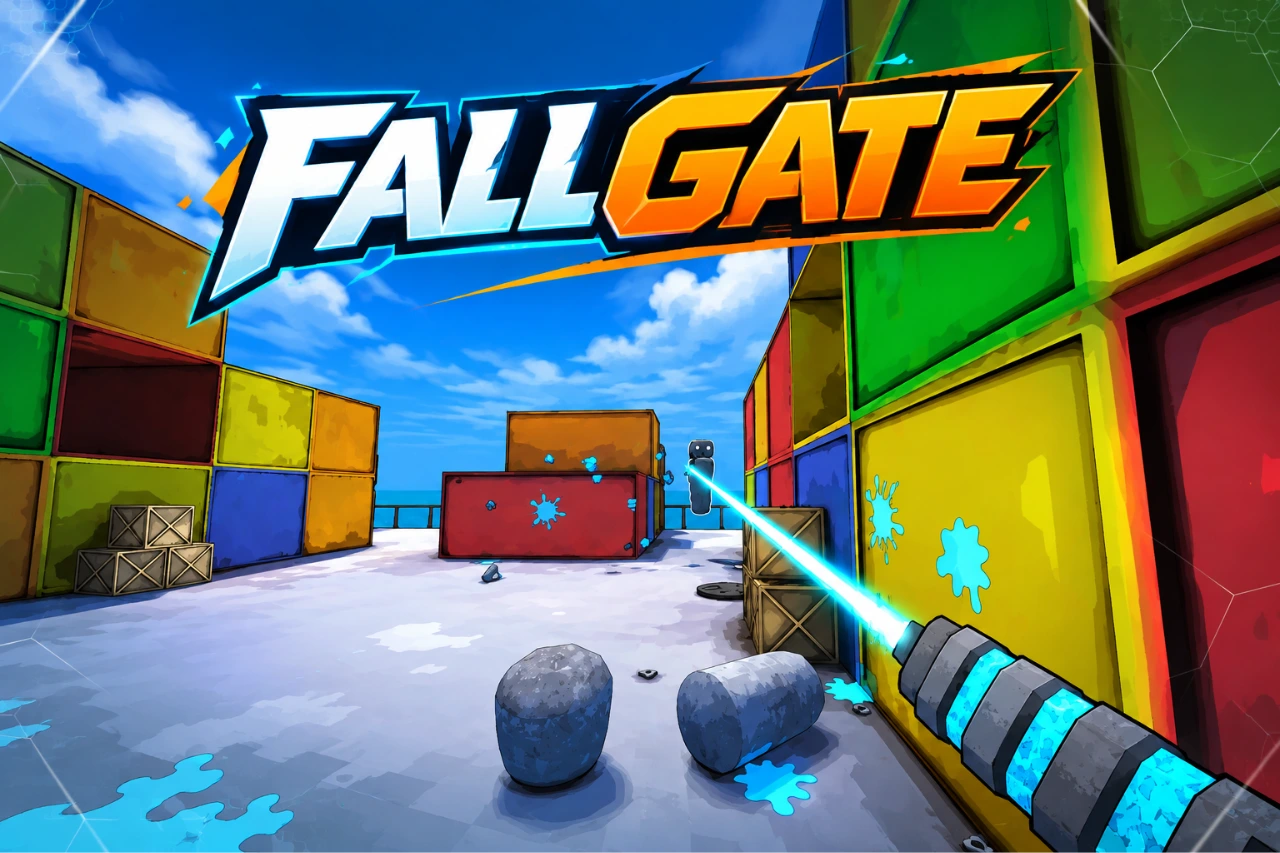
Fallgate is a multiplayer arena first-person shooter inspired by classic arena shooters. Public information about the game describes features including competitive player-versus-player combat, advanced movement, projectile-based weapons and parkour-style gameplay.
But completing a playable game was only part of the process.
Making a game is different from releasing one
For first-time developers, one of the lessons came after much of the development work was already complete: creating a game and preparing a game for public release are two different challenges.
The team still had to work through the process of establishing its Steam presence, completing verification requirements, preparing store information and visual assets, creating a trailer and presenting the game to potential players.
That process took additional time and introduced an entirely different set of skills.
A game project therefore became more than an exercise in Unity or game mechanics. The students were also encountering elements of product presentation, communication, publishing and project management.
Fallgate reaches Steam
Fallgate now has a public presence on Steam and is listed as a Free to Play multiplayer arena FPS intended for Early Access.
At the time of writing, the game is still shown publicly as Coming Soon.
The team’s initial strategy is deliberately simple: make the game available for free, attract players and learn from what happens next.
Instead of treating the first public version as a finished product, the students plan to use player feedback to understand what works, what does not and which improvements or new features may be worth developing.
Monetization may be explored in later versions, but the immediate objective is more fundamental: build a player community, collect feedback and continue improving the game.
Learning does not stop when the course ends
There is another part of this story that matters.
The students behind Fallgate are not professional developers, and this is not the result of years of formal game-development education.
For the team member whose journey began with Unity and Blender lessons, those courses were a starting point rather than the end of the learning process. Much of what followed was self-directed: encountering a problem, searching for a solution, experimenting, failing, fixing it and moving to the next problem.
That is often how practical digital skills develop.
A structured course can provide the first vocabulary, tools and direction. A real project then creates reasons to learn things that were never part of the original lesson.
More than game-development skills
It would be easy to look at Fallgate and focus only on Unity, programming or game design. But the project illustrates a much wider collection of skills.
- Game development and technical problem-solving
- Digital art and working with 3D assets
- Remote collaboration
- Communication in English
- Testing and iteration
- Project planning
- Preparing digital content for publication
- Responding to feedback
For high-school students who have not yet chosen a university path or career, experiences like these can be particularly valuable. A teenager does not need to decide at 16 that game development will become a lifelong profession.
Creating something real is already useful because it helps reveal what they enjoy, what they are good at and what they may want to learn next.
From consuming technology to creating with it
The most interesting part of this story may not be that a group of teenagers managed to put a game on Steam.
It is what happened before that.
A computer that had primarily been used to consume entertainment gradually became a tool for learning and creation. Online lessons led to experimentation. Experimentation led to a school project. The school project created confidence to attempt something independent. And that independent idea eventually became a multiplayer game being prepared for real players.
The amount of screen time is only part of the story. What young people are doing with that screen time can matter just as much.
For parents and educators, that may be the more useful lesson from Fallgate. An interest in gaming does not automatically become an interest in technology, programming or digital creation. But given the right starting point and an opportunity to build something meaningful, playing can sometimes become curiosity — and curiosity can become creation.
Fallgate is currently listed as Coming Soon. Details about the game and its Early Access plans may change as development continues.